Peter: The Faith That Walks on Water
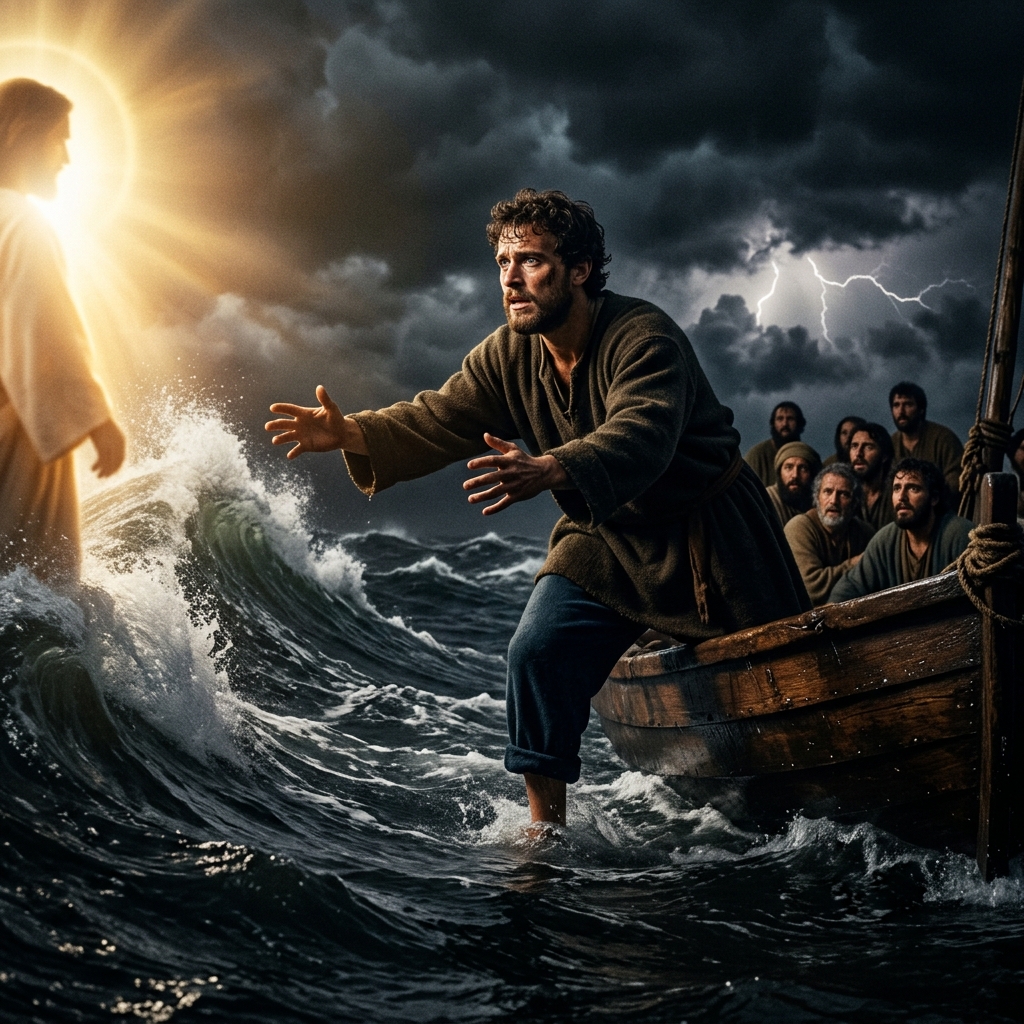
«Lord, if it is you, command me to come to you on the water. He said, Come. So Peter got out of the boat and walked on the water and came to Jesus. But when he saw the wind, he was afraid, and beginning to sink he cried out, Lord, save me. Jesus immediately reached out his hand and took hold of him, saying to him, O you of little faith, why did you doubt?» — Matthew 14:28-31
There is a moment in the Gospel that summarizes the entire human experience of faith in just three steps: getting out of the boat, walking on the water, sinking. And in those three steps, God reveals something that no easy-victory sermon could ever teach us: that genuine faith is not the absence of fear, but the decision to take the first step in spite of it.
Peter is, of all the disciples, the one who most resembles us. He is not the wisest, nor the most patient, nor the most consistent. He is impulsive, contradictory, sometimes cowardly and sometimes reckless. But he is also the only one who had the courage to ask Jesus to call him out to walk on the water. And the only one who actually did it.
The Moment Before the Leap: Faith That Acts Without Complete Certainty
«Lord, if it is you, command me to come to you on the water.» — Matthew 14:28
It was the fourth watch of the night — between three and six in the morning. The twelve were in the boat, exhausted and terrified by the storm. Then they saw someone walking on the water and thought it was a ghost.
Jesus spoke to them: «Take heart; it is I. Do not be afraid.» And in that moment, among twelve men who had already witnessed miracles, who had already heard extraordinary teachings, who had just eaten multiplied bread hours before — only one opened his mouth to ask for the impossible.
Peter did not say: “I’m going.” He did not jump without asking. He said something deeper: «If it is you, command me to come.» He asked for a command. He recognized that he could not do this by his own strength or his own will. He could only walk on the water if Jesus called him.
True faith is not blind audacity. It is obedience to a voice we recognize as greater than our fear.
And Jesus said a single word: «Come.»
Steps on the Water: What Happens When We Obey
«So Peter got out of the boat and walked on the water and came to Jesus.» — Matthew 14:29
This verse is one of the most extraordinary in all of the New Testament — not for what it says, but for what it does not say. It mentions no doubts in that moment. It speaks of no hesitation. Peter got out of the boat and walked.
Can you imagine what that felt like? The wind striking his clothes. The water — cold, dark, deep — holding his feet supernaturally. The sound of the waves. The distance between him and the boat growing step by step. And Jesus there, ahead, watching him.
Those steps are the most faithful image of what it means to live by faith. Not that the wind ceased. Not that the sea calmed. Not that the circumstances became safe. The wind was still howling. The water was still churning. But Peter walked, because his eyes were fixed on Jesus and not on the storm.
The Bible calls this living «by faith, not by sight» (2 Corinthians 5:7). It does not mean ignoring reality. It means choosing which reality carries more weight: the one your eyes see or the one your faith holds.
The Sinking: When Sight Overcomes Faith
«But when he saw the wind, he was afraid, and beginning to sink he cried out, Lord, save me.» — Matthew 14:30
The text says exactly when he began to sink: when he looked at the wind. Not when the wind increased. Not when a wave struck him. When he turned his eyes from Jesus to the storm.
This is the most honest spiritual principle in existence: what you fix your gaze upon determines whether you walk or sink.
And here is what many miss when reading this story: Peter did not sink because he lacked faith. He sank because his faith was divided. He had enough faith to get out of the boat. He had enough faith to walk the first steps. But at some point, the reality of the wind became more convincing than the reality of the Word that had called him.
Does that sound familiar? Perhaps you have stepped out of your own “boat” — you have taken the step of faith, obeyed the call, begun to walk. And then the wind showed up: the illness, the debt, the betrayal, the endless waiting. And you began to sink — not because God stopped holding you, but because you started looking more at the storm than at Him.
The Extended Hand: Grace That Reaches the Depths
«Jesus immediately reached out his hand and took hold of him.» — Matthew 14:31
Two words in the Greek text that change everything: «immediately.» Not after Peter demonstrated sufficient faith. Not after he repented of having doubted. Not after a period of testing.
Immediately.
Jesus did not wait for Peter to resolve his fear. He did not let him sink to teach him a lesson about persistence. At the very instant Peter cried out — with a prayer of just three words, the shortest in the Gospel: «Lord, save me!» — Jesus’s hand was already reaching toward him.
This is grace. It does not reward merit. It responds to the cry.
And notice what Jesus did after saving him: He rebuked him. Not with cruelty, but with a question that has echoed in the heart of every believer who has sunk for centuries: «O you of little faith, why did you doubt?»
The question is not an accusation. It is an invitation to reflection: Why did you look at the wind when I was right in front of you? Why did you give more weight to what you saw than to what I had spoken?
Peter’s Restoration: The Faith That Falls and Rises Again
Peter’s story does not end on that lake. It ends years later, transformed.
The same man who sank in the waters would also deny Jesus three times in the courtyard of the high priest (Luke 22:54-62). The same one who swore he would never abandon Him fled when real danger arrived. But he was also the one Jesus specifically sought after the resurrection — not to reproach him, but to restore him:
«Simon, son of John, do you love me?» — John 21:17
Three times the question. One for each denial. And with each answer from Peter, a new commission: «Feed my sheep.»
Jesus did not discard Peter for his failures. He made him the foundation of the church. The first Pentecost sermon, which opened the hearts of three thousand people to the gospel, was preached by the same man who months earlier had trembled before a servant girl (Acts 2).
God does not look for those who never sink. He looks for those who, while sinking, cry out His name.
What Peter Teaches Us About Faith
Peter’s faith was not perfect — it was real. And there lies its deepest lesson.
Faith is not a permanent state of spiritual invulnerability. It is a daily practice, a repeated decision, a continuous choice to look at Jesus instead of at the wind. And when we fail in that choice — when we look at the wind, when we begin to sink, when we deny, when we flee — grace does not run out. The hand remains extended.
If today you are in the middle of your own storm, if you feel the water rising and your strength failing, perhaps the only prayer you need is the shortest one in the Gospel:
«Lord, save me.»
That is enough. It has always been enough.
Declaration of Faith
Declare this today with conviction:
«Lord, I acknowledge today that I do not always walk on the water. Sometimes, like Peter, I turn my eyes from You and look at the wind. Sometimes I sink. But today I choose to look back at You. I choose to trust Your voice more than what my eyes see. Thank You that the moment I cry out, Your hand is already reaching toward me. I do not need perfect faith — I need You. And if I fall, I will cry Your name again, because I know You will never let me go. Amen.»
«But those who wait on the Lord shall renew their strength; they shall mount up with wings like eagles, they shall run and not be weary, they shall walk and not faint.» — Isaiah 40:31
Prayer and Declaration of Faith
"Almighty God, Master of the oceans and Lord of every storm: Today I draw near to You, confessing the moments when I have fixed my eyes upon raging winds and swirling waves instead of listening to Your voice calling me to walk. I acknowledge that I have allowed the terror of difficult circumstances to cause me to sink into doubt. Like Peter amidst the churning sea, I cry out from the depths of my being: Lord, save me!
Today I choose to lock my gaze upon Your face and step out of the boat of human comfort in bold obedience to Your command. I declare that Your mighty hand reaches out in this very hour to lift me up, steadying my feet above the deep and restoring stillness to my soul. I proclaim that no storm will engulf my life, for the King of glory rides with me, and with a single word He commands the wind and waves to be still. In the glorious name of Jesus Christ. Amen."