Matthew 2:19-23 — The Return to Nazareth: God's Silent Guidance and the Power of the Ordinary
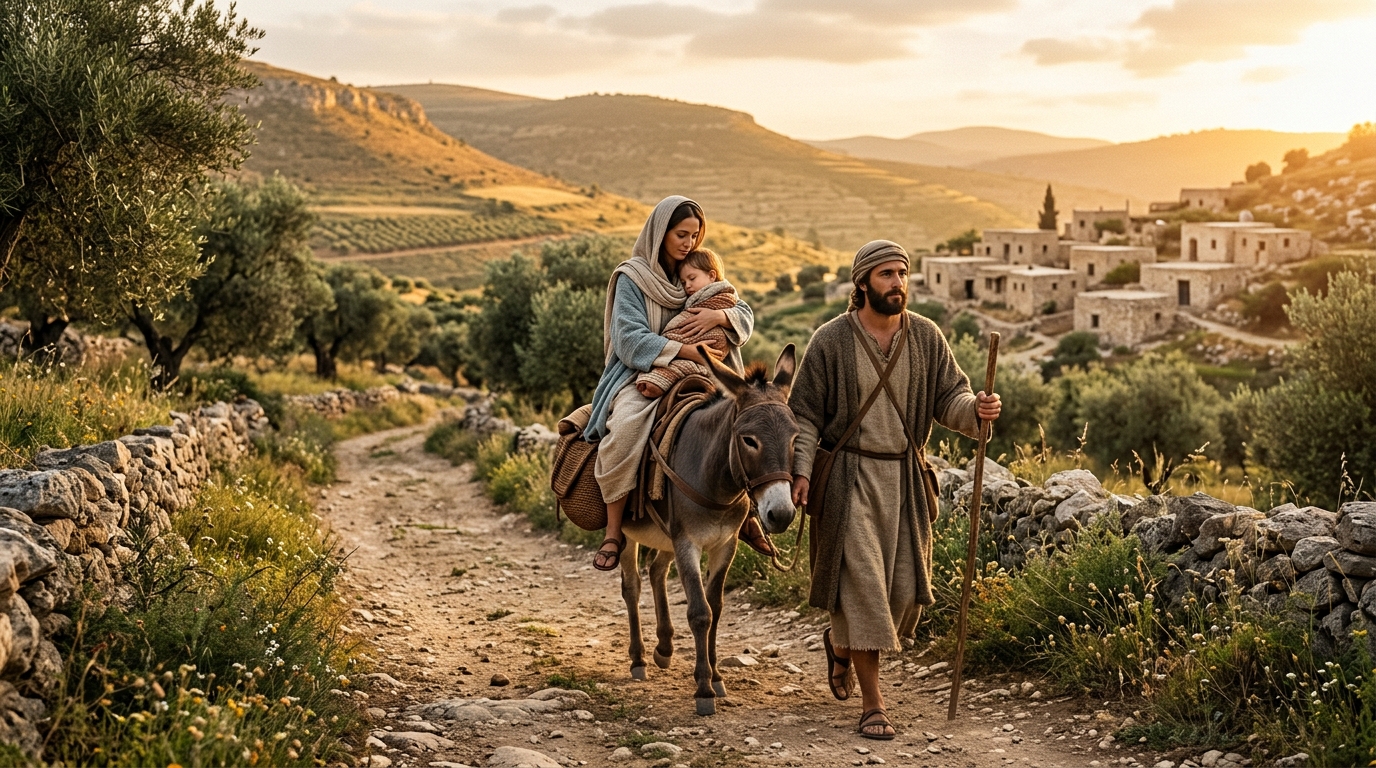
"Now when Herod was dead, behold, an angel of the Lord appeared in a dream to Joseph in Egypt, saying, 'Arise, take the young Child and His mother, and go to the land of Israel, for those who sought the young Child’s life are dead.' Then he arose, took the young Child and His mother, and came into the land of Israel. But when he heard that Archelaus was reigning over Judea instead of his father Herod, he was afraid to go there. And being warned by God in a dream, he turned aside into the region of Galilee. And he came and dwelt in a city called Nazareth, that it might be fulfilled which was spoken by the prophets, 'He shall be called a Nazarene.'" — Matthew 2:19-23
We often picture the walk of faith as a nonstop procession of visible triumphs, spectacular celestial interventions, and perfectly straight roads free of ambiguity. Yet the Gospels present with refreshing honesty the truth that God’s redemptive tapestry is most frequently woven in the quiet cadence of daily life—through long seasons of patient waiting in foreign territory, through prudent decisions in the face of sudden threats, and through geographical detours that may appear to be human improvisations but are, in truth, masterfully directed by eternal providence.
The account of the Holy Family’s journey back from Egypt to Nazareth brings the opening two chapters of the Gospel of Matthew to their fitting completion. Following the heart-wrenching tragedy in Bethlehem and the vulnerability of life in exile, this narrative presents neither an imperial victory march into the palaces of Jerusalem nor a dazzling public coronation. Rather, it reveals a humble family learning to step in harmony with the gentle whisper of God, discovering that the glory of the Savior of the world was destined to mature in the quiet anonymity of a carpenter's workshop in Galilee.
1. The end of exile: God’s perfect timing for the return (vv. 19-20)
The angel of the Lord had previously instructed Joseph: «remain there until I bring you word» (Matthew 2:13). Learning to wait upon God’s call when dwelling outside our comfort zone is one of the most testing spiritual disciplines. In Egypt, Joseph and Mary had no permanent roots; they lived with their cloaks girded, aware that this was not their final home, yet honoring the divine timetable appointed to safeguard the young Child.
Verse 19 introduces a brand-new season: «Now when Herod was dead...». The fiercest earthly rulers, the most ruthless oppressive systems, and the trials that seem everlasting all possess an inevitable expiration date. Human pride that dares to oppose God invariably collapses under its own corruption, yet the Word of God and His kingdom purposes stand unshakable forever. Heaven’s summons arrives at the exact ordained instant: «Arise, take the young Child and His mother, and go to the land of Israel, for those who sought the young Child’s life are dead». When God concludes a season of shelter and opens the door for return, He does so knowing His sovereignty has neutralized the mortal peril.
2. Faith that honors prudence: Legitimate fear and divine direction (vv. 21-22)
Joseph's obedience is once again immediate and resolute: «Then he arose, took the young Child and His mother, and came into the land of Israel». Yet upon crossing near the familiar borders, a harsh geopolitical reality shakes their plans: «But when he heard that Archelaus was reigning over Judea instead of his father Herod, he was afraid to go there».
Historical records abundantly vindicate Joseph’s apprehension: Archelaus was notorious for ruthless savagery, having ordered the slaughter of thousands of worshippers in the Temple courts at the very start of his rule. It is profoundly instructive that the Scriptures offer no rebuke for Joseph’s natural dread. Genuine biblical faith is neither blind recklessness nor foolish fanaticism that denies empirical danger; mature faith walks hand-in-hand with wisdom and actively seeks guidance. Rather than stubbornly marching into Judea or collapsing into paralysis, Joseph prayed and listened, and God answered with pinpoint clarity: «being warned by God in a dream, he turned aside into the region of Galilee». When we trust the Lord, spiritual prudence and supernatural guidance harmonize to keep our steps secure.
3. Providential detours: When a change of plans is God's will (v. 22)
Joseph very likely harbored a natural, honorable aspiration to settle near Bethlehem, in the historic heartland of David, where the young Messiah might be raised close to the spiritual center of the nation. Yet external dangers compelled a radical detour northward toward Galilee of the Gentiles.
How often in our personal journeys do our well-crafted plans hit unexpected roadblocks—whether through closed doors, sudden corporate restructuring, or economic turbulence? In such crossroads, it is easy to misinterpret the diversion as an embarrassing defeat. Yet the biblical narrative reminds us that what appears to be a desperate Plan B to human eyes is, in the sovereign mind of God, the eternal Plan A all along. God employs the unexpected corners of life to shield us from hidden pitfalls and reposition us precisely where His purpose will bear the richest fruit.
4. The mystery of Nazareth: Divine glory hidden in the ordinary (v. 23)
The destination of their journey is astonishingly unassuming: «And he came and dwelt in a city called Nazareth».
Nazareth was an obscure, hilly hamlet tucked away in the countryside of lower Galilee—a rustic village that was never once mentioned in the Old Testament, nor in the esteemed rabbinic writings or historical chronicles of the era. Indeed, the prevalent cultural prejudice of the day was summarized in Nathanael’s blunt question: «Can anything good come out of Nazareth?» (John 1:46). Had human ambition scripted the biography of the King of kings, it would surely have selected an influential rabbinical academy in Jerusalem, a royal palace, or a bustling metropolis such as Rome or Alexandria.
Yet God operates by a vastly higher economy of grace. He appointed for His Son thirty years of hidden life—years filled with cedar shavings and sawdust, humble neighborly interactions, and faithful growth in stature, wisdom, and prayer. In Nazareth, Jesus shared ordinary meals, learned a trade, and lived in quiet simplicity. The return to Nazareth consecrates our everyday existence: it proclaims that you do not require a dazzling public stage or the applause of cultural elites to be intensely fruitful in God's kingdom. Within the quiet routines of your home, the honest duties of your work, and your unseen acts of daily faithfulness, the Lord is shaping eternal fruit.
5. «He shall be called a Nazarene»: The humble shoot transforming the world (v. 23)
Matthew concludes with a profound theological declaration: «that it might be fulfilled which was spoken by the prophets, 'He shall be called a Nazarene'».
Scholars emphasize two rich dimensions within this prophetic synthesis: first, it echoes the Hebrew prophetic title Netser (Isaiah 11:1), the gentle «Branch» or «Shoot» springing up from the severed stump of Jesse; second, it captures the overarching witness of the prophets that the Messiah would walk in lowliness, despised and rejected by the proud of this world (Psalm 22:6-8; Isaiah 53:2-3).
By growing up in Nazareth, Jesus entered from His earliest childhood into the lived experience of the overlooked, the modest, and those whom society labels with disdain. The Lord of all creation did not come to be pampered by worldly dignitaries, but to walk alongside the humble and redeem all who feel unseen. If your life currently feels quiet or unnoticed by the world’s bright spotlights, remember that the greatest treasure of human history was cultivated in Nazareth. God’s favor does not seek marble palaces; it makes its home in yielded, trusting hearts.
Prayer and Declaration of Faith
"Lord God Almighty, Father of grace and Sovereign Ruler of all my days: As I behold the steadfast faithfulness with which You directed the steps of Joseph and Mary on their journey back to Nazareth, I come before Your presence surrendering all impatience, frustration, and anxiety regarding the unexpected turns of my life. Forgive me for the moments when I have attempted to rush Your timing, when I have complained because my cherished plans met sudden diversions, and when I have disparaged seasons of quiet, unseen preparation. I acknowledge with reverent humility that Your thoughts are infinitely higher than mine, that no earthly hostility can derail Your purpose for my life, and that You use even perceived delays to navigate me safely to the place of divine blessing.
Today, I rise in faith declaring that my life, my loved ones, and my calling rest secure beneath the shelter of Your sovereign providence. I embrace with gratitude and joyful peace the exact season and place You have assigned me, confident that in the ordinary, the modest, and the routine moments of my days You are forming my character and displaying Your eternal glory. I renounce the hollow pursuit of human applause and the weariness of superficial striving; I take refuge in the gentle comfort of Your Holy Spirit and rest in the assurance that Your angels encamp around me in all my ways. May every step I take today be guided by Your radiant light, and may my life shine as a living testament to the humble, transformative love of Jesus. In the glorious name of Jesus Christ. Amen."