Mark 2:1-12 — Jesus Heals the Paralytic: The Power of Forgiveness and Total Restoration
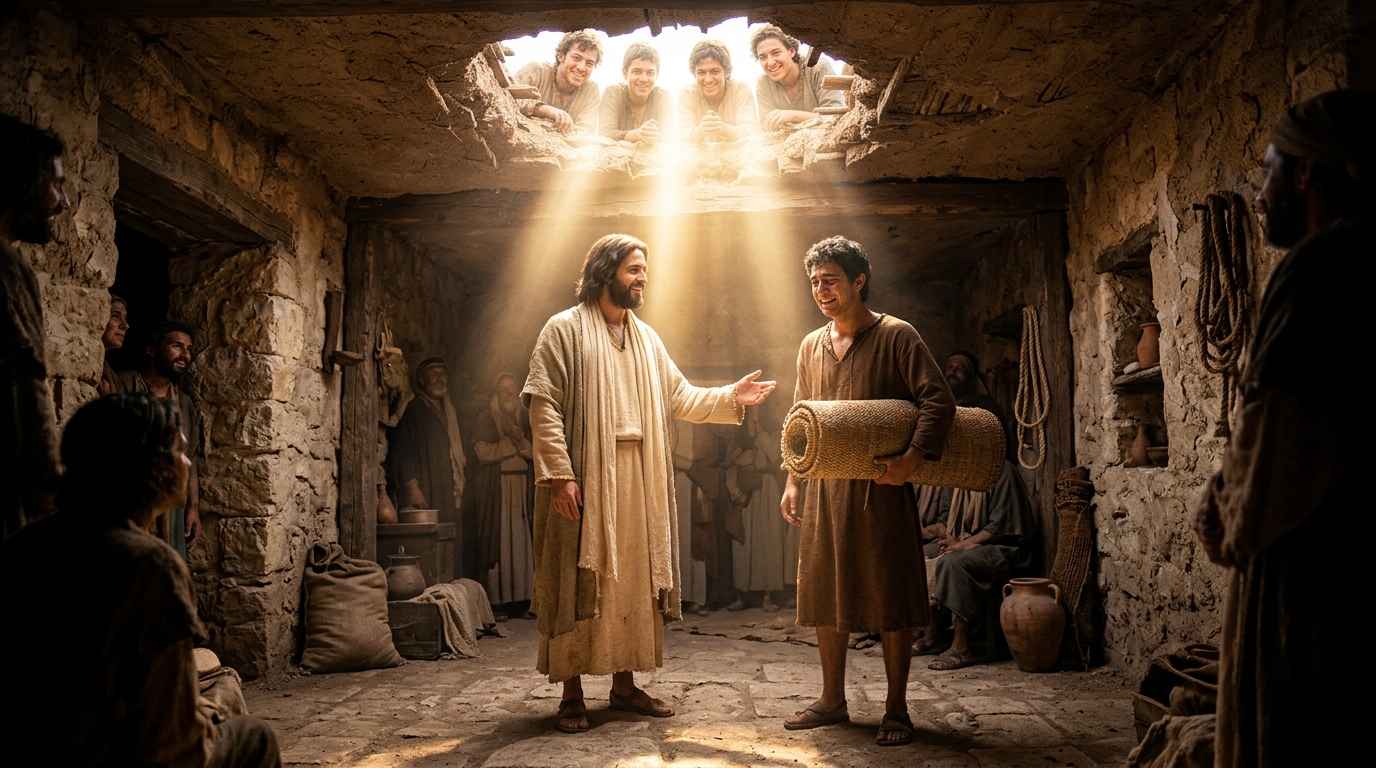
"A few days later, when Jesus again entered Capernaum, the people heard that he had come home. They gathered in such large numbers that there was no room left, not even outside the door, and he preached the word to them. Some men came, bringing to him a paralyzed man, carried by four of them. Since they could not get him to Jesus because of the crowd, they made an opening in the roof above Jesus by digging through it and then lowered the mat the man was lying on. When Jesus saw their faith, he said to the paralyzed man, “Son, your sins are forgiven.” Now some teachers of the law were sitting there, thinking to themselves, “Why does this fellow talk like that? He’s blaspheming! Who can forgive sins but God alone?” Immediately Jesus knew in his spirit that this was what they were thinking in their hearts, and he said to them, “Why are you thinking these things? Which is easier: to say to this paralyzed man, ‘Your sins are forgiven,’ or to say, ‘Get up, take your mat and walk’? But I want you to know that the Son of Man has authority on earth to forgive sins.” So he said to the man, “I tell you, get up, take your mat and go home.” He got up, took his mat and walked out in full view of them all. This amazed everyone and they praised God, saying, “We have never seen anything like this!”" — Mark 2:1-12
There are seasons in human life when a person experiences profound, suffocating paralysis. It is not always an affliction of muscles or bones; very often, the most debilitating forms of paralysis take root within the inner sanctuary of the soul: emotional paralysis born from a devastating betrayal, the spiritual immobility caused by lingering guilt, or the mental exhaustion of feeling entirely powerless to alter painful circumstances. In such states of distress, life shrinks down to a lonely mat of limitations, fear, and sorrow.
Inside a crowded home in Capernaum, Jesus orchestrates one of the most revealing encounters in all of Scripture. Four faithful companions refuse to let their friend's condition be the final word. Undeterred by the impenetrable crowd, they climb onto the roof, dig through clay and beams, and lower the paralyzed man directly before the Master. Jesus’ response cuts through outward expectations: He does not begin by addressing the motionless limbs, but speaks directly to the bruised heart, demonstrating that while God cares deeply about our physical wholeness, His supreme priority is the spiritual reconciliation and peace of the human soul.
1. Faith in Community: Love That Removes Roofs
This paralyzed man possessed no capacity to reach Jesus on his own; he was utterly dependent on the physical strength and spiritual resolve of four devoted friends. When they discovered that every doorway and window was blocked by the pressing crowd, they neither surrendered to despair nor returned home in defeat. They climbed to the housetop, pulled away tiles and dried mud, and carefully lowered their friend right before the eyes of the Savior.
The biblical narrative highlights an extraordinary phrase: “When Jesus saw their faith...” Genuine faith is never merely an isolated, intellectual sentiment; it is a shared, compassionate reality that takes bold, loving action. How often in our darkest trials our own spiritual strength runs dry, and it is the prayers, presence, and unwavering intercession of faithful friends that carry us into the presence of God. Surrounding yourself with individuals who nourish your faith, and standing ready to carry the mat of those who are suffering, is the purest reflection of Christ’s love in our world.
2. Healing the Hidden Root: Peace Within Before Strength Without
Both the curious crowd and the four friends anticipated that Jesus would immediately command the paralyzed man to stand and walk. Yet the Lord’s opening words catch everyone off guard: “Son, your sins are forgiven.”
With tender affection, Jesus first calls him “Son,” restoring his dignity and identity before addressing anything else. The Master recognized that this man carried a burden far more crushing than physical immobility: the heavy weight of hidden guilt, the painful social stigma of his culture that equated illness with divine displeasure, and the tormenting fear of being forsaken by God. Jesus addresses the true root of suffering. A person may possess physical vitality, yet remain utterly paralyzed if their heart is consumed by shame or bitterness; conversely, when the soul tastes the unconditional pardon of God, supernatural vitality springs forth to conquer external hardship.
3. Heavenly Authority on Earth: Power Over the Doubting Heart
Jesus’ declaration provoked instant, silent indignation among the religious teachers: “Who can forgive sins but God alone?” Their theological premise was technically correct: only the Creator possesses the sovereign prerogative to pardon offenses against heaven. What they failed to see was that the One standing in their midst was God clothed in human flesh.
Jesus lays bare their hidden thoughts by posing a piercing question: “Which is easier: to say, ‘Your sins are forgiven,’ or to say, ‘Get up, take your mat and walk’?” To human ears, speaking words of forgiveness seems effortless because its spiritual reality cannot be verified by the eyes; ordering a lifelong paralytic to stand instantly is visibly impossible. Jesus sovereignly binds both together: He performs the undeniable physical miracle so that all present may know beyond a shadow of doubt that He holds absolute authority to cleanse human consciences and erase sin forever.
4. From the Mat to a Living Testimony: Rise, Pick Up Your Mat, and Go Home
The command of Jesus reverberates with divine power: “I tell you, get up, take your mat and go home.” That same man who moments earlier was carried by four friends leaped to his feet, rolled up the very mat that had long imprisoned him, and walked out in full view of everyone, igniting a wave of holy awe and praise to God.
That mat holds profound spiritual meaning. It was no longer a symbol of defeat or a monument to helplessness; it had become a trophy of God's redemptive grace. The very circumstances that once held you captive—your past wounds, family heartaches, past failures, or seasons of depression—are transformed by Jesus into a vibrant testimony of His goodness. When the Lord restores you, He does not leave you helpless; He sends you home wrapped in His peace, so that your family and community may witness that there is no pit so deep that His loving hand cannot lift you out.
Prayer and Declaration of Faith
"Lord God Almighty, Father of boundless grace and supreme Healer of my soul: Today I come before your throne of mercy, laying down every inner paralysis, every heavy burden of fatigue, and every lingering shadow of guilt that has immobilized my spirit. I confess that I have often looked for superficial solutions to my pain, forgetting that only your intimate, forgiving love can heal the deepest roots of my fears and grant me true, lasting peace. I thank you with all my heart for the faithful friends who have carried me in prayer during my darkest hours.
Today I receive in the depths of my being your life-giving word of restoration: I believe that in Christ Jesus my sins are forgiven and my soul is sealed with your eternal comfort. By the power of your Holy Spirit, I rise up from every place of emotional defeat, take authority over discouragement, and step boldly forward into the purpose you have destined for my days. I transform the trials of my past into a living altar of praise, declaring that I will walk in victory and be an instrument of your healing compassion for those who are hurting. In the glorious name of Jesus Christ. Amen."