Luke 2:1-21 — The Birth of Jesus: Glory in the Highest and Peace on Earth
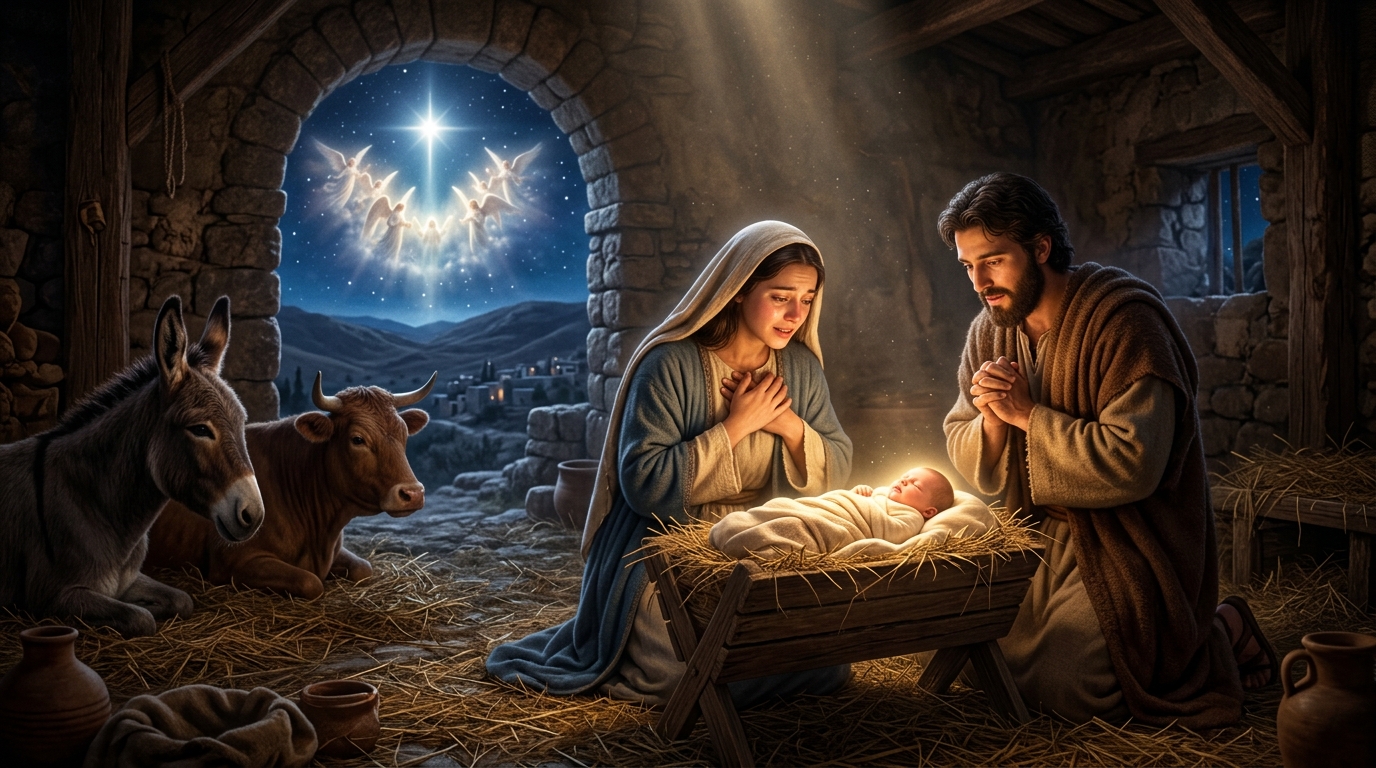
"And she brought forth her firstborn Son, and wrapped Him in swaddling cloths, and laid Him in a manger, because there was no room for them in the inn... Then the angel said to them, 'Do not be afraid, for behold, I bring you good tidings of great joy which will be to all people. For there is born to you this day in the city of David a Savior, who is Christ the Lord... And suddenly there was with the angel a multitude of the heavenly host praising God and saying: Glory to God in the highest, and on earth peace, goodwill toward men!... But Mary kept all these things and pondered them in her heart." — Luke 2:7, 10-11, 13-14, 19
Human nature instinctively associates true greatness with magnificent palaces, imperial fanfare, geopolitical dominance, and overwhelming displays of power. Yet, when the Creator of the universe chose to step visibly into human history to rescue humanity from the grip of darkness, He chose the path of tender vulnerability, quiet wonder, and profound humility. There were no purple carpets or heralds sounding golden trumpets in the imperial halls of Rome; there was only a rustic stable tucked into a quiet Judean village, a feeding trough lined with straw, and a young couple learning to lean fully upon the invisible providence of God.
The narrative of Jesus' birth in Luke 2:1-21 represents the pinnacle of divine grace breaking into our world. In this breathtaking passage, the evangelist Luke weaves historical precision and theological depth to demonstrate how the decrees of earthly monarchs unknowingly serve heaven's eternal purposes, how marginalized shepherds keeping night watch were chosen as the very first guests at redemption's banquet, and how authentic peace is not the mere absence of conflict, but the living presence of God's Son dwelling among us.
1. The imperial census and God's sovereign providence (Luke 2:1-5)
The historical chronicle begins with an imperial decree from the heart of the Roman Empire: “And it came to pass in those days that a decree went out from Caesar Augustus that all the world should be registered”.
From a strictly human perspective, Mary and Joseph appeared to be helpless pawns caught in the bureaucratic machinery of an occupying superpower. A young mother in the final stages of a delicate pregnancy, compelled to undertake an arduous journey of more than seventy miles across rugged hills from Nazareth to Bethlehem, seemed to be an unfortunate turn of fate. Yet behind the emperor’s signature stood the sovereign, orchestrating hand of God.
Seven centuries earlier, the prophet Micah had declared that the ruler of Israel would come forth from Bethlehem Ephrathah (Micah 5:2). Caesar Augustus thought he was merely ordering an empire-wide tax registration to assess tribute; in reality, he was serving as an unwitting instrument of divine providence, moving the holy family to the exact geographic coordinate where ancient prophecy had to be fulfilled. When external circumstances, government decisions, or unexpected life transitions appear to disrupt your plans, remember this unshakeable truth: God never loses control. He orchestrates even the most inconvenient twists of life to position you right at the heart of His eternal purpose.
2. Glory in simplicity: A manger for the King of kings (Luke 2:6-7)
Upon arriving in Bethlehem, the drama deepens into profound tenderness: “And she brought forth her firstborn Son, and wrapped Him in swaddling cloths, and laid Him in a manger, because there was no room for them in the inn”.
The phrase “there was no room for them” tragically captures the chronic blindness of human busy-ness. The village caravansaries were overcrowded with travelers consumed by administrative duties, family business, and immediate personal comfort. No one suspected that just a few paces away, in the quiet shelter of a stone cave meant for livestock, the Eternal Word was taking His first breath in mortal flesh.
The manger—the feeding trough where beasts of burden ate—became the crib for the Bread of Life. God did not choose to be born in a palace guarded by sentries so that no human being, however broken, impoverished, or marginalized, would ever fear drawing near to Him. Had Christ arrived surrounded by royal gatekeepers, the humble would have been barred from His presence. But by arriving in an open, unprotected stable, Jesus made Himself accessible to every seeking heart. God does not demand grand earthly pretensions; He simply seeks an open, humble space within our souls where His grace can transform our darkness into light.
3. Good tidings in the night of the humble (Luke 2:8-12)
Heaven's first birth announcement was delivered neither to King Herod's court nor to the religious hierarchy of the Jerusalem Temple. God dispatched His angelic ambassador to the dark, windswept hills of Bethlehem: “Now there were in the same country shepherds living out in the fields, keeping watch over their flock by night. And behold, an angel of the Lord stood before them, and the glory of the Lord shone around them, and they were greatly afraid”.
In first-century culture, shepherds were regarded as second-class citizens, socially despised and religiously marginalized because their night duties prevented them from keeping strict ceremonial washings. They endured bitter cold, watching over sheep—many of which were destined for temple sacrifices. Yet it was to these forgotten night-watchers that heaven granted the greatest headline in human history.
The angel's message begins with the characteristic reassurance of God’s Kingdom: “Do not be afraid, for behold, I bring you good tidings of great joy which will be to all people. For there is born to you this day in the city of David a Savior, who is Christ the Lord”. The divine sign was not an intimidating spectacle of lightning and thunder, but the quiet beauty of supreme vulnerability: “a Babe wrapped in swaddling cloths, lying in a manger”. God honors those the world overlooks. In your darkest and most routine nights, when you feel unnoticed by those around you, the light of divine mercy can break through with glad tidings of eternal hope.
4. The song of heaven: Peace and reconciliation for humanity (Luke 2:13-14)
Suddenly, the quiet hillside erupted into a celestial sanctuary as an army of angels tore open the night sky with transcendent praise: “Glory to God in the highest, and on earth peace, goodwill toward men!”.
The angelic anthem reveals the dual heart of the Gospel: vertical glory ascending to God, and horizontal peace descending upon humanity. In the ancient Mediterranean world, the celebrated Pax Romana was enforced through the sword, military subjugation, and ruthless pacification. But the peace Christ brings—heaven's sacred Shalom—is not a fragile political truce. It is the comprehensive reconciliation of the human soul with God, the healing of a guilty conscience, and the deep inner quiet of knowing that we are unconditionally loved, forgiven, and accepted by our Creator.
Christ stepped down to bridge the chasm that sin had opened between heaven and earth. Where estrangement once reigned, God declared His eternal goodwill toward us.
5. The response of faith: Eagerness, wonder, and Mary's contemplative heart (Luke 2:15-21)
The response of the shepherds offers a radiant blueprint for active faith: “And they came with haste and found Mary and Joseph, and the Babe lying in a manger”. They did not delay or debate; they acted upon the Word, beheld the fulfillment of the promise, and then openly shared what had been revealed to them, returning to their flocks glorifying and praising God.
And nestled in the midst of this whirlwind of wonder and unexpected visitors, Scripture preserves an exquisite portrait of spiritual depth: “But Mary kept all these things and pondered them in her heart”.
Mary refused to let the noise of the moment dissipate the sacred mystery of what God was doing. To “ponder” (sumballousa) means to fit the pieces together thoughtfully, holding every promise of God up to the light of reality with patient, reverent trust. Eight days later, in faithful submission to God's covenant, the child was given the name JESUS (Yeshua: “The Lord is salvation”)—the name above every name, given by the angel before His conception.
The nativity of Jesus calls us to cast aside worldly hurry and spiritual pride in order to return to what truly matters. Do not allow the clamor of this life to crowd out the Savior. Open the humble manger of your heart today, and let the light of Bethlehem flood your soul with unshakeable, everlasting peace.
Prayer and Declaration of Faith
"Lord God Almighty, Father of boundless grace and Creator of heaven and earth: In this holy moment, my soul bows in reverent awe, quiet wonder, and deep humility before the sublime mystery of the birth of Your Son, Jesus Christ, in Bethlehem. Forgive me for the times when the clamor of this busy world, the relentless demands of daily life, and the pursuit of temporal things have crowded my heart, leaving no room for Your presence within me. Today I acknowledge that Your supreme majesty does not dwell in the vanity of earthly palaces, but in the simplicity of a heart fully surrendered to Your love.
Today I receive with unspeakable joy the proclamation of the angelic hosts: that in Christ a Savior has been born for me—the Prince of Peace who dispels every shadow of fear and reconciles my life to You forever. Like Mary, I choose to treasure Your holy promises and ponder them in the depths of my spirit; and like the shepherds, I arise with eager joy to worship You and declare Your wonders to this generation. Fill me with Your supernatural peace, illuminate my path with the humble radiance of the manger, and let my life become a living sanctuary where Your glory shines continually. In the glorious name of Jesus Christ. Amen."