John 3:1-21 — Jesus and Nicodemus: Born Again and the Redeeming Love of God
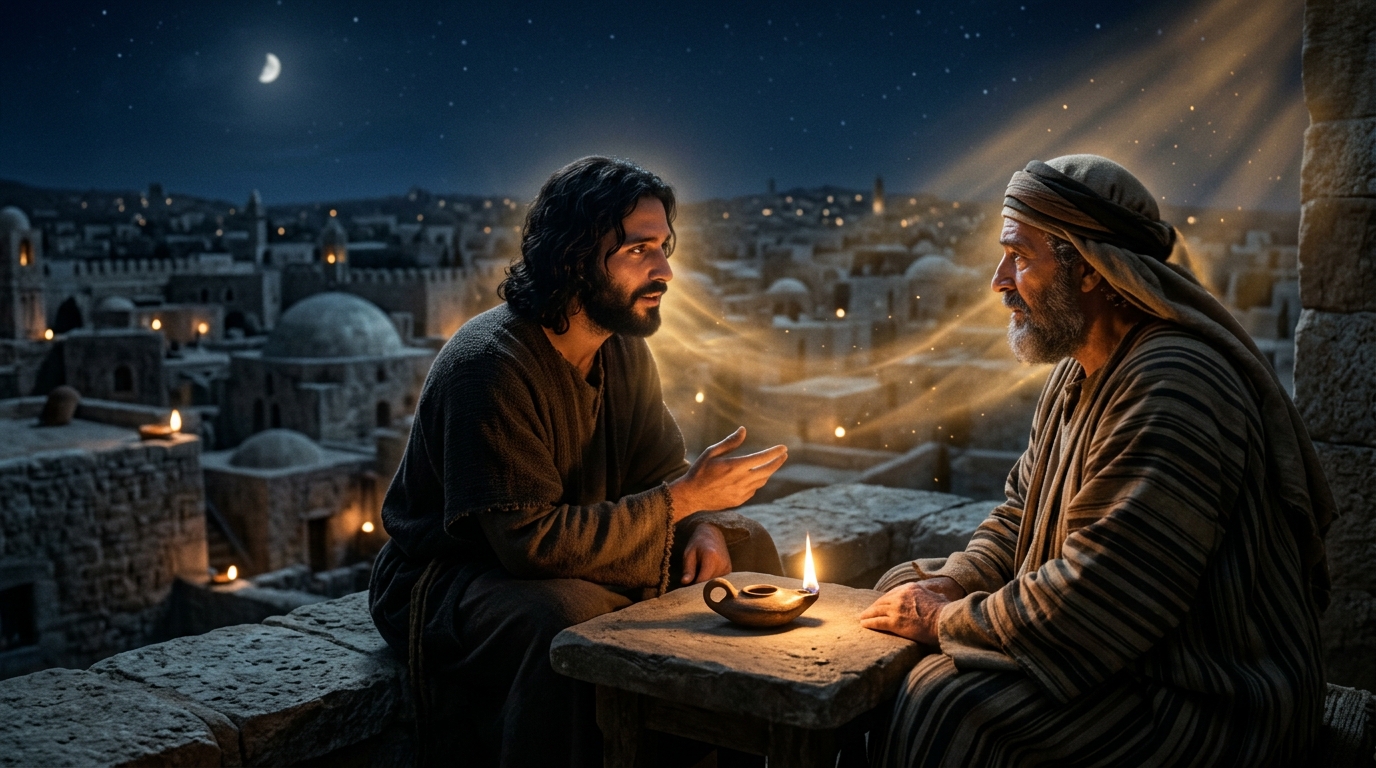
"Jesus replied, 'Very truly I tell you, no one can see the kingdom of God unless they are born again.'... 'Flesh gives birth to flesh, but the Spirit gives birth to spirit. The wind blows wherever it pleases. You hear its sound, but you cannot tell where it comes from or where it is going. So it is with everyone born of the Spirit.'... For God so loved the world that he gave his one and only Son, that whoever believes in him shall not perish but have eternal life. For God did not send his Son into the world to condemn the world, but to save the world through him." — John 3:3, 6, 8, 16-17
Have you ever felt trapped within the stubborn limits of your own humanity? You resolve to reshape your character, quell lingering anxiety, or overcome destructive habits relying solely on sheer willpower. Yet, sooner or later, you find yourself back at the very same starting point: exhausted from attempting to polish the exterior when what your soul truly craves is a comprehensive renewal from within. This tension is not unique to modern times; it is an existential crossroads as ancient as humanity itself.
It was precisely this inner thirst that prompted Nicodemus, a prominent religious scholar and member of the Jewish Sanhedrin, to seek Jesus under the protective cover of night. Their encounter, brilliantly documented in John 3:1-21, represents one of the most foundational dialogues in the Gospels. In this intimate nocturnal meeting, Jesus dismantles the illusion of self-made righteousness, introduces the breathtaking mystery of the new birth through the Holy Spirit, and unveils the glorious heartbeat of the Gospel: a love so vast that it came not to condemn, but to rescue all who step out from the shadows into His marvelous light.
1. The night visit: The frontier of human moral effort (John 3:1-4)
Nicodemus embodied the absolute pinnacle of religious achievement, intellectual learning, and moral rectitude in his society. He was respected by peers and meticulously versed in sacred Scripture. Yet, in the quiet chambers of his conscience, he harbored a persistent spiritual hunger that decades of legalistic observance had failed to satisfy. Whether motivated by fear of peer disapproval or seeking an unhurried, private conversation, he approached Jesus by night.
His opening words attempted to maintain polite academic decorum: “Rabbi, we know that you are a teacher who has come from God...”. But Jesus, who perceives the deepest thoughts of the heart, bypassed conversational pleasantries and pierced straight to the heart of humanity's true dilemma: “Very truly I tell you, no one can see the kingdom of God unless they are born again”.
Nicodemus’s bewildered response—“How can an old man be born again?”—vividly illustrates our mortal inclination to interpret supernatural realities through purely physical lenses. Nicodemus was picturing a biological impossibility; Jesus was diagnosing an indispensable spiritual rebirth. The issue was not merely reforming, improving, or repairing the old life; it was receiving an entirely new life generated from above (anothen).
2. Water and Spirit: The rebirth flesh cannot produce (John 3:5-7)
Addressing the teacher’s confusion, Jesus illuminated the nature of this divine transformation: “Very truly I tell you, no one can enter the kingdom of God unless they are born of water and the Spirit. Flesh gives birth to flesh, but the Spirit gives birth to spirit”.
Against the backdrop of the Hebrew Scriptures, water and Spirit immediately evoke the prophetic promise of Ezekiel 36:25-27: “I will sprinkle clean water on you, and you will be clean... And I will put my Spirit in you and move you to follow my decrees”. Being born of water points to the cleansing wash of divine forgiveness that removes the guilt of the past, while being born of the Spirit speaks of the impartation of a new, divine nature that renews the inner being.
Attempting to please God and walk in holy peace relying solely on the “flesh”—on mortal discipline, moral effort, or human resolve—is an impossible pursuit. The flesh can only generate more flesh: exhaustion, pride, and eventual defeat. We must surrender our self-sufficiency so that the Spirit of God can plant within us His incorruptible seed, empowering us to love, forgive, and live in holiness.
3. The wind of the Spirit: Mystery, sovereignty, and freedom (John 3:8-13)
To illustrate how this inner miracle unfolds, Jesus drew upon an exquisite metaphor from the natural world: “The wind blows wherever it pleases. You hear its sound, but you cannot tell where it comes from or where it is going. So it is with everyone born of the Spirit”.
In both ancient Hebrew and biblical Greek, the same term (ruach / pneuma) signifies both “wind” and “spirit”. The wind is invisible, untamed, sovereign, and beyond human control: no mortal hand can seize it or dictate its course. Yet its power is unmistakable: it sways towering trees, cools the scorched earth, and fills the sails of ships upon the sea.
This is precisely how the Holy Spirit moves across human hearts: we cannot manipulate God through religious formulas or forecast the exact timetable of His intervention. But when His grace touches a soul, the fruit is undeniable. Those born of the Spirit are liberated from the tyranny of ego and step into supernatural freedom, carried along by a divine breath that constantly renews their mind and guides their path.
4. The Son of Man lifted up: The gaze of saving faith (John 3:14-15)
When Nicodemus once again asked, “How can this be?”, Jesus pointed him back to a pivotal moment in Israel’s wilderness journey: “Just as Moses lifted up the snake in the wilderness, so the Son of Man must be lifted up, that everyone who believes may have eternal life in him”.
In Numbers 21, when Israelites were dying from venomous serpent bites, God commanded Moses to fashion a bronze serpent and raise it high upon a pole. Anyone who had been bitten, upon fixing their eyes in faith upon that bronze serpent, was healed and lived.
In the same way, the cross of Jesus Christ is the divine pole where the Son of God bore the deadly venom of human sin. Experiencing the new birth does not demand a heroic ascent up a mountain of good deeds; it requires lifting the eyes of faith to the crucified and risen Christ. Whoever fixes their trust upon Him does not perish under the poison of guilt and despair, but receives eternal life as an unmerited gift of grace.
5. The supreme love and the call to walk in the light (John 3:16-21)
The climax of Jesus’ teaching to Nicodemus unveils the greatest and most famous declaration in all of Scripture: “For God so loved the world that he gave his one and only Son, that whoever believes in him shall not perish but have eternal life. For God did not send his Son into the world to condemn the world, but to save the world through him”.
God is not a harsh tyrant waiting for mortals to fail so He can strike in wrath; He is a loving Father whose immense compassion took the initiative to sacrifice the treasure of heaven in order to reclaim a lost and wounded race. The primary mission of Christ’s coming was not condemnation, but complete and loving salvation.
Yet Jesus underscored humanity’s profound responsibility before this love: “This is the verdict: Light has come into the world, but people loved darkness instead of light because their deeds were evil... But whoever lives by the truth comes into the light, so that it may be seen plainly that what they have done has been done in the sight of God”. Nicodemus’s night visit did not have to remain his permanent state. Jesus invited him to step out of the shadows into the fullness of day. And Nicodemus would indeed answer that call—later speaking up courageously in Jesus’ defense and bringing costly spices to honor His crucified body at the tomb. We too are invited to abandon the shadows of pretense, bring our brokenness into the open, and let the radiant light of Christ illuminate our lives.
Prayer and Declaration of Faith
"Sovereign Lord God Almighty, Father of boundless mercy and Fountain of all heavenly light: Today I bow before your holy presence, casting aside all garments of self-reliance, religious pride, and empty human striving. I confess that like Nicodemus in the dark, I have often attempted to manage my own life and reform my character through the weakness of the flesh, only to reap exhaustion and disappointment. Forgive me for resisting the mystery of your grace and for clinging to the comfortable shadows of my own mortal securities.
Today, I open the doors of my heart to the regenerating breath of your Holy Spirit, receiving by faith the matchless gift of being born again in Christ Jesus. I gaze upon the Savior lifted up upon the cross, declaring that in His sacrifice I have received complete forgiveness, divine healing, and eternal life. I take refuge in the glorious truth that you sent not your Son to condemn me, but to save me with everlasting love. I boldly step out of the darkness and into the brilliance of your light, asking that my thoughts, words, and actions be sanctified by your truth and bear joyful witness to your glory all the days of my life. In the glorious name of Jesus Christ. Amen."