John 2:13-25 — The Cleansing of the Temple: Zeal for God's House and the True Sanctuary
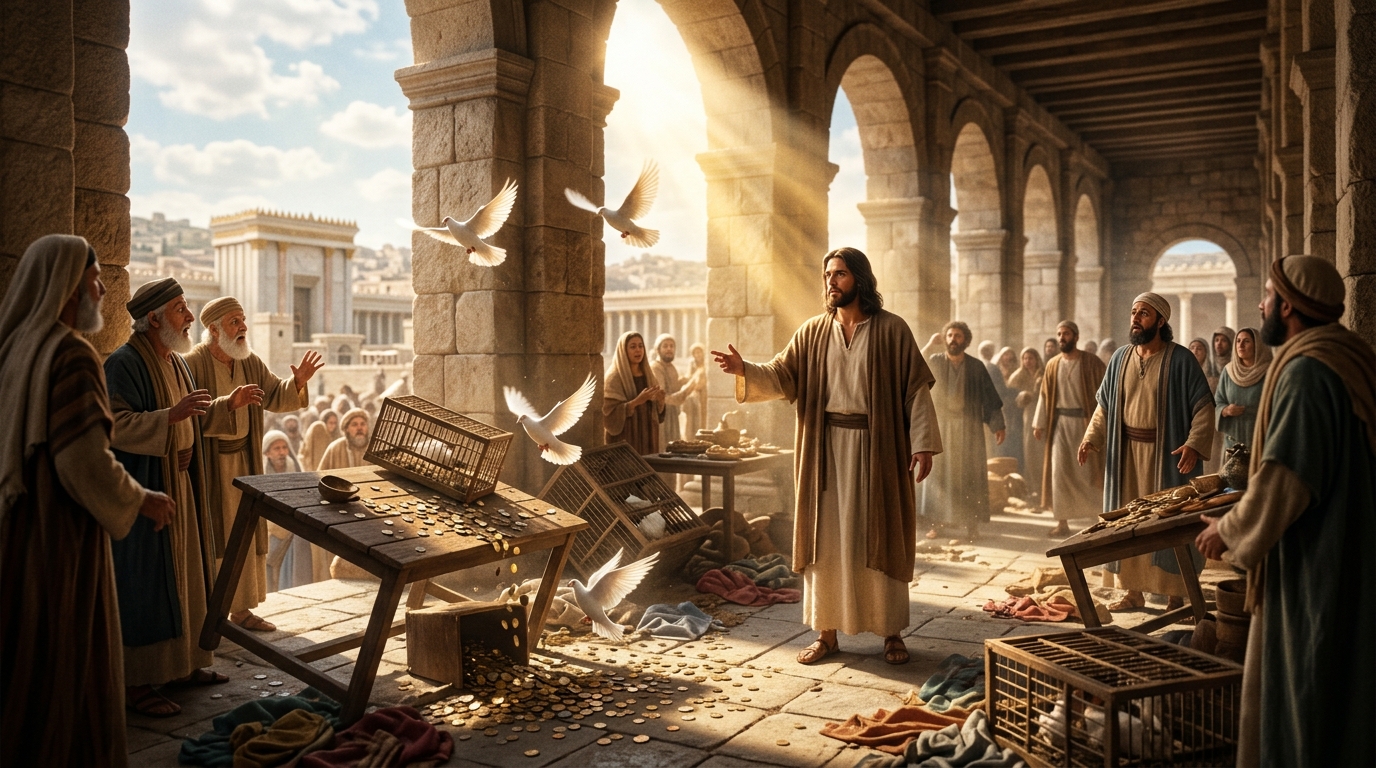
"And He found in the temple those who sold oxen and sheep and doves, and the money changers doing business. When He had made a whip of cords, He drove them all out of the temple, with the sheep and the oxen, and poured out the changers’ money and overturned the tables. And He said to those who sold doves, 'Take these things away! Do not make My Father’s house a house of merchandise!' Then His disciples remembered that it was written, 'Zeal for Your house has eaten Me up'... Jesus answered and said to them, 'Destroy this temple, and in three days I will raise it up'... But He was speaking of the temple of His body." — John 2:14-17, 19, 21
It is all too easy to reduce Jesus to a harmless caricature of passive sentimentality who never confronts compromise. Yet the Gospel accounts reveal a Savior whose deep tenderness toward the brokenhearted walked hand-in-hand with an uncompromising, burning passion for the holiness and truth of God. When Jesus looked upon wounded individuals, He was moved to tears; but when He observed religious systems exploiting worshipers and reducing communion with the Creator to a transactional marketplace, His holy zeal blazed with the fury of a refining fire.
In John 2:13-25, we encounter one of the most decisive and revealing moments of Christ’s earthly ministry: the cleansing of the Temple in Jerusalem during the Passover festival. This dramatic event was neither an unhinged burst of human temper nor an uncontrolled loss of composure; it was a sovereign, prophetic act of royal authority. Jesus arrived to demolish the barriers of religious hypocrisy, liberate the sacred courts from commercial greed, and announce that the ultimate dwelling place between God and humanity is not an earthly edifice crafted from stone, but His own resurrected body.
1. The desecrated court: When devotion is corrupted into commerce (John 2:13-14)
The setting of this confrontation is the Court of the Gentiles, the only precinct within the sprawling Temple complex where non-Jewish foreigners were permitted to gather, pray, and seek the living God. What was designed to be a quiet sanctuary of prayer, contemplation, and global fellowship had degenerated into a raucous, overcrowded bazaar filled with livestock, cages of doves, and tables of predatory currency brokers.
Under the guise of “accommodating” pilgrims fulfilling legal sacrificial duties, the temple aristocracy had engineered a lucrative commercial monopoly. Sincere worshipers traveling vast distances across the ancient world hoping for reconciliation were greeted by the deafening bleating of sheep, ruthless haggling over livestock prices, and exorbitant exchange rates required to swap foreign coinage for the temple shekel.
Jesus grieved over how human greed had crowded out sacred prayer, effectively slamming the door of heaven in the faces of humble seekers. This scene serves as a piercing warning to us today: it is deceptively easy to slide from a vibrant, living faith into transactional religion, attempting to strike bargains with God for personal favors while forgetting that divine grace is a gift that can neither be bought nor sold.
2. Holy zeal that cleanses: Restoring the Father's house (John 2:15-17)
Confronted by this corruption, Jesus’ response was deliberate, calculated, and invested with sovereign authority: “When He had made a whip of cords, He drove them all out of the temple... and overturned the tables. And He said to those who sold doves, ‘Take these things away! Do not make My Father’s house a house of merchandise!’”.
The whip of cords was not fashioned to injure human flesh, but as a recognized prophetic symbol of divine discipline—the Shepherd driving intruders out of His pasture. With a single declaration of His voice, tables piled with coins crashed to the pavement, and caged doves—symbols of innocence exploited for profit—were set free into the open air.
Notice the unprecedented filial title Jesus employs: “My Father’s house”. In the Hebrew prophets, the sanctuary was reverently referred to as “the house of God,” but Jesus claims an intimate, eternal oneness with the Heavenly Father. Watching this astonishing scene unfold, the disciples recalled the words of Psalm 69:9: “Zeal for Your house has eaten Me up”. Jesus’ zeal was not reckless fanaticism; it was an incandescent love that refuses to permit what is sacred to be profaned. When Christ enters our lives, He does not negotiate peacefully with our secret idols; He overturns the tables of self-reliance and greed so that our hearts may be restored as houses of pure worship.
3. The true sanctuary: The sign of the resurrection (John 2:18-22)
Shaken by this direct assault on their religious and financial establishment, the temple authorities did not pause to consider whether their practices were unjust. Instead, they demanded proof of His authority: “What sign do You show to us, since You do these things?”.
Jesus replied with an enigmatic prophecy that confounded His contemporaries: “Destroy this temple, and in three days I will raise it up”. The religious leaders scoffed, pointing to Herod’s architectural marvel, which had already undergone forty-six years of painstaking masonry. “Will You raise it up in three days?”, they mocked.
Yet the Apostle John unveils the profound mystery: “But He was speaking of the temple of His body”. Jesus was announcing the greatest spiritual revolution in human history. The physical temple of Jerusalem possessed an expiration date; it would soon be reduced to rubble (as occurred in AD 70). The authentic meeting ground between heaven and earth was no longer a stone sanctuary, but the living Person of Jesus Christ. At the cross, that sanctuary was torn down in death; yet on the third day, by bursting forth from the tomb in triumphant resurrection, He established an indestructible Temple where all who believe receive unhindered, eternal access to the Father.
4. The Lord who perceives the depths of the human heart (John 2:23-25)
The narrative concludes with a sober assessment of superficial faith: “Now when He was in Jerusalem... many believed in His name when they saw the signs which He did. But Jesus did not commit Himself to them, because He knew all men... for He knew what was in man”.
Many were swept up by the spectacle of Jesus' miracles, but their enthusiasm was skin-deep—a fleeting fascination with wonder rather than genuine surrender. Jesus is never seduced by the applause of the crowd or pious exterior performances. He looks directly into the inner motives of our hearts: our hidden fears, our silent rationalizations, and our deepest longings.
Knowing that Jesus perceives everything about us should not evoke terror; it brings profound relief. We have no need to wear hypocritical masks before Him. He knows our brokenness intimately, yet He loves us with an everlasting love and invites us to be cleansed, forgiven, and renewed by His grace.
5. Our hearts: Living sanctuaries for God's glory
The Apostle Paul would later remind the church: “Do you not know that your body is the temple of the Holy Spirit who is in you?” (1 Corinthians 6:19). What Jesus accomplished in the stone courts of Jerusalem, He desires to do today within the sanctuary of your soul.
Invite the Lord to walk through the corridors of your inner life. Ask Him to overturn the tables of chronic worry, bitterness, self-absorption, and every compromise that hinders your walk with Him. When you allow Christ’s purifying love to clear away the clutter, the peace of God takes up residence within you, making your life a radiant dwelling place where His presence shines brightly for all to see.
Prayer and Declaration of Faith
"Lord God Almighty, Father of all holiness and inexhaustible Fountain of grace: Today I come before Your sacred presence acknowledging the supreme majesty of Your name and surrendering every chamber of my being at Your feet. Forgive me for the seasons when I allowed the clamor of the world, selfish ambitions, and religious complacency to clutter the temple of my heart, reducing intimate worship to empty, transactional routine. I recognize that You do not seek hollow outward performances, but a humble, transparent, and contrite spirit that worships You in spirit and in truth.
Today I swing wide the doors of my soul for Your holy zeal to purify me from within. Overturn every table of anxiety, pride, hidden resentment, and worldly compromise; set my spirit free like the doves released in Your sanctuary, and establish my life as a perpetual dwelling of prayer, gratitude, and sincere reverence. I declare that my hope rests not in fleeting earthly structures, but in the resurrected and eternal Temple of Your Son, Jesus Christ, through whom I have everlasting life, total forgiveness, and direct communion with You. Preserve my heart in integrity, strengthen my steps in obedience, and let my everyday life glorify Your holy name. In the glorious name of Jesus Christ. Amen."