John 2:1-12 — The Wedding at Cana: The First Miracle and the New Wine of Grace
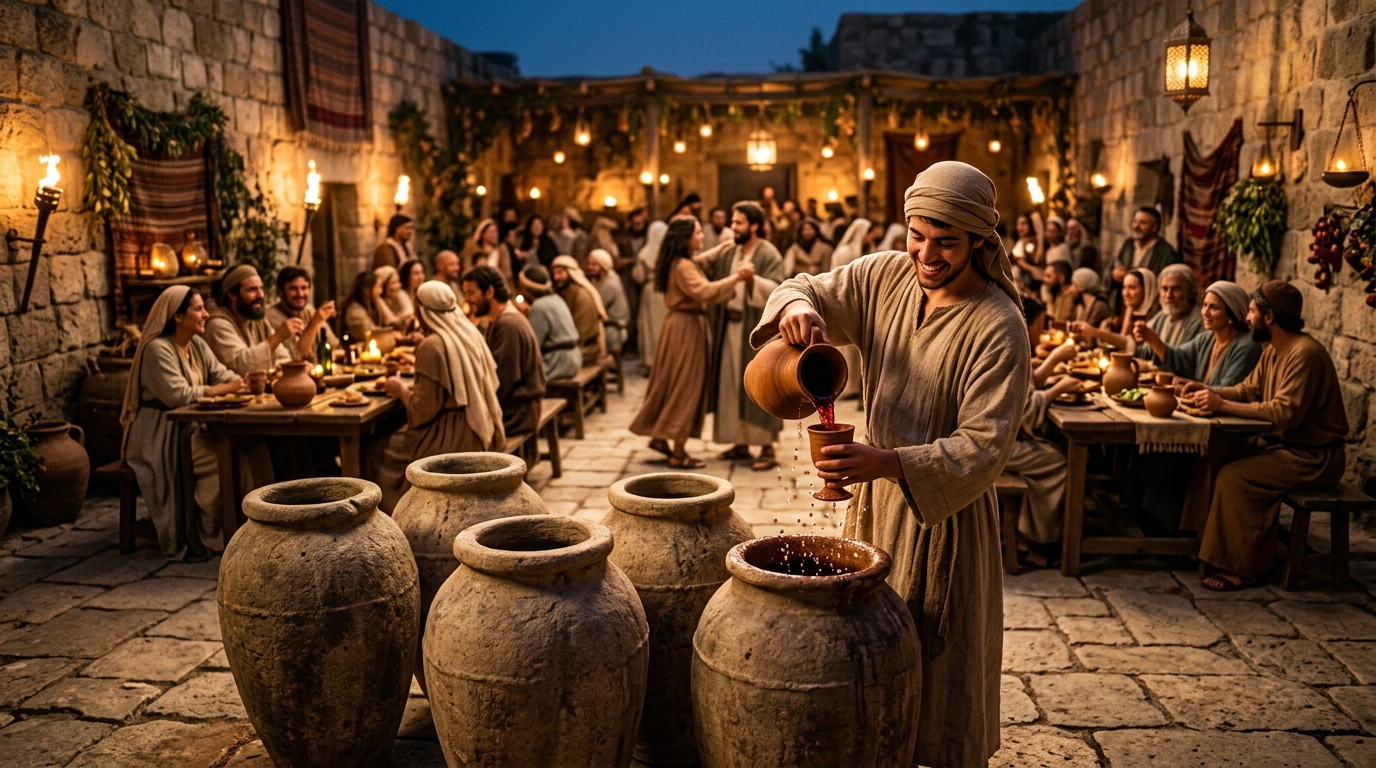
"His mother said to the servants, 'Do whatever he tells you.'... Jesus said to the servants, 'Fill the jars with water.' And they filled them up to the brim... When the master of the feast tasted the water now become wine, and did not know where it came from... he called the bridegroom and said to him, 'Everyone serves the good wine first, and when people have drunk freely, then the poor wine. But you have kept the good wine until now.' This, the first of his signs, Jesus did at Cana in Galilee, and manifested his glory. And his disciples believed in him." — John 2:5, 7, 9-11
In our daily journey, few circumstances feel as unsettling as discovering that our resources have run dry just when we need them most. It may be our mental strength depleted after exhausting seasons, our financial savings stretched thin by unexpected hardship, or that deep inner joy that slowly evaporates beneath the relentless pressure of routine. In the wedding traditions of the ancient Near East, running out of wine was far more than an awkward logistical oversight; it brought profound social embarrassment upon the newlywed couple and cast a lasting shadow over the celebrating families.
Yet, it is precisely within this scene of human vulnerability that the Gospel of John introduces the opening act of our Lord’s public ministry. Jesus did not inaugurate His supernatural signs in the imperial courts of Rome or among the solemn scholarly assemblies of Jerusalem, but within the affectionate warmth of a family gathering in a humble Galilean village named Cana. There, where impending scarcity threatened to extinguish joy, God revealed that His presence has the power to redeem our crises and transform the ordinary into a blessing that surpasses all imagination.
1. When the Wine Runs Out: The Limits of Human Provision (John 2:1-3)
Mary’s brief words to Jesus carried penetrating honesty: «They have no wine». Four simple words were enough to summarize the hosts’ impending ruin. In biblical imagery, wine symbolizes celebratory gladness, abundance, and the warmth of shared fellowship. When the passage notes that the wine ran out, it accurately reflects the fragile nature of all worldly resources: sooner or later, any joy founded purely upon earthly circumstances runs dry.
What is remarkable about this narrative is the person to whom Mary turns. She does not attempt to disguise the problem before the guests or run around in frantic search of worldly remedies; she approaches Jesus directly. The initial step toward experiencing God’s restoring power in our lives is authentic honesty: acknowledging in His presence that our personal strength has reached its limit, that we lack answers, and that our stone jars stand empty.
2. The Golden Rule of Faith: «Do Whatever He Tells You» (John 2:4-5)
Mary’s instruction to the attendants holds one of the brightest spiritual principles in the entire New Testament: «Do whatever he tells you». Within this simple sentence lies the key to divine intervention. Mary does not prescribe to Jesus how to resolve the crisis, nor does she impose deadlines or demand a specific procedure; she yields the entire circumstance to the Master’s sovereign wisdom and commands the servants to render unconditional obedience.
Too often, we hinder God's transformative work because we try to dictate how He ought to answer our prayers. We ask for miracles tailored to our preferences and aligned with our personal timetables. Genuine faith, however, rests completely in the Lord’s discernment, even when His instructions run contrary to conventional logic or feel counterintuitive in the midst of urgent need.
3. Six Stone Water Jars: Grace Fills the Emptiness of Outer Ritual (John 2:6-8)
Standing nearby were «six stone water jars there for the Jewish rites of purification». These vessels were designated for outward ceremonial washings prescribed by religious traditions. Made of heavy stone, they were impervious to ritual defilement, yet they symbolized the inability of external ordinances to renew the human heart.
Jesus instructed the servants: «Fill the jars with water», and they filled them «up to the brim». This detail is deeply inspiring: God does not ask us to produce sophisticated solutions; He asks for whatever we have at hand, even plain water, yet He calls us to offer it wholeheartedly, without holding anything back. That water of ceremonial washing was miraculously turned into the rich new wine of grace. External religion could only wash hands on the outside; Jesus descends into our lives to fill the soul on the inside with supernatural and everlasting joy.
4. The Best Wine Kept for the Last: Surpassing Human Expectation (John 2:9-10)
When the master of the feast tasted the liquid drawn from the jars, he was astonished and summoned the bridegroom to exclaim: «Everyone serves the good wine first, and when people have drunk freely, then the poor wine. But you have kept the good wine until now».
The world typically offers its best at the beginning: fleeting excitement, dazzling promises, and superficial pleasures that steadily wear down and lose their luster. The economy of grace operates in reverse. With God, our best days are never behind us. The seasons of greatest spiritual fruitfulness, deepest maturity, and unshakable peace are not fading memories of the past; they are promises waiting to unfold as we walk in communion with Him. Even if you feel that your life has entered an exhausting plateau, the Lord specializes in renewing hope and keeping the finest wine of His love to crown your future.
5. The Manifestation of Glory and the Deepening of Faith (John 2:11-12)
The Apostle John closes the scene with a profound theological statement: «This, the first of his signs, Jesus did at Cana in Galilee, and manifested his glory. And his disciples believed in him». John intentionally avoids calling miracles mere wonders; he terms them signs (semeia), because their ultimate purpose is not to entertain curiosity, but to point to the divine identity and redemptive power of the Savior.
At Cana, the disciples witnessed that the young teacher from Nazareth whom they had chosen to follow possessed sovereign authority over creation, tender empathy for the hidden heartaches of an ordinary family, and the power to usher in the kingdom of heaven right in the midst of everyday life. Their nascent faith was anchored and fortified. Today, that same glory remains ever present for anyone willing to invite the Master into their home and heart.
Prayer and Declaration of Faith
"Lord God Almighty, Father of boundless goodness and Fountain of all grace: Today we bow before Your throne acknowledging that our own strength frequently falters and our human provisions run dry. We humbly confess that across different areas of our lives we have faced the emptiness of our soul: seasons when joy seems to fade, when anxiety over daily needs clouds our inner peace, and when we feel inadequate to meet the challenges surrounding us. Forgive us for the moments we sought fulfillment in perishable things or doubted Your tender providence when circumstances seemed bleak. Today we bring our empty jars before You, laying down all worry, shame, and fear upon the altar of Your unfailing love.
We stand in faith today proclaiming that You are the God who turns the ordinary water of our weakness into the rich new wine of Your Spirit and glory. We declare over our lives, families, and callings that no lack shall determine our destiny, for Your living presence dwells among us to bless, restore, and satisfy our hearts with abundant grace. We resolve to listen to Your voice and do whatever You tell us, resting in the joyful certainty that You always reserve the best for the last and that Your paths overflow with lasting comfort, victory, and peace. In the glorious name of Jesus Christ. Amen."